
Professional Services provided by Concept Environmental Solutions Limited
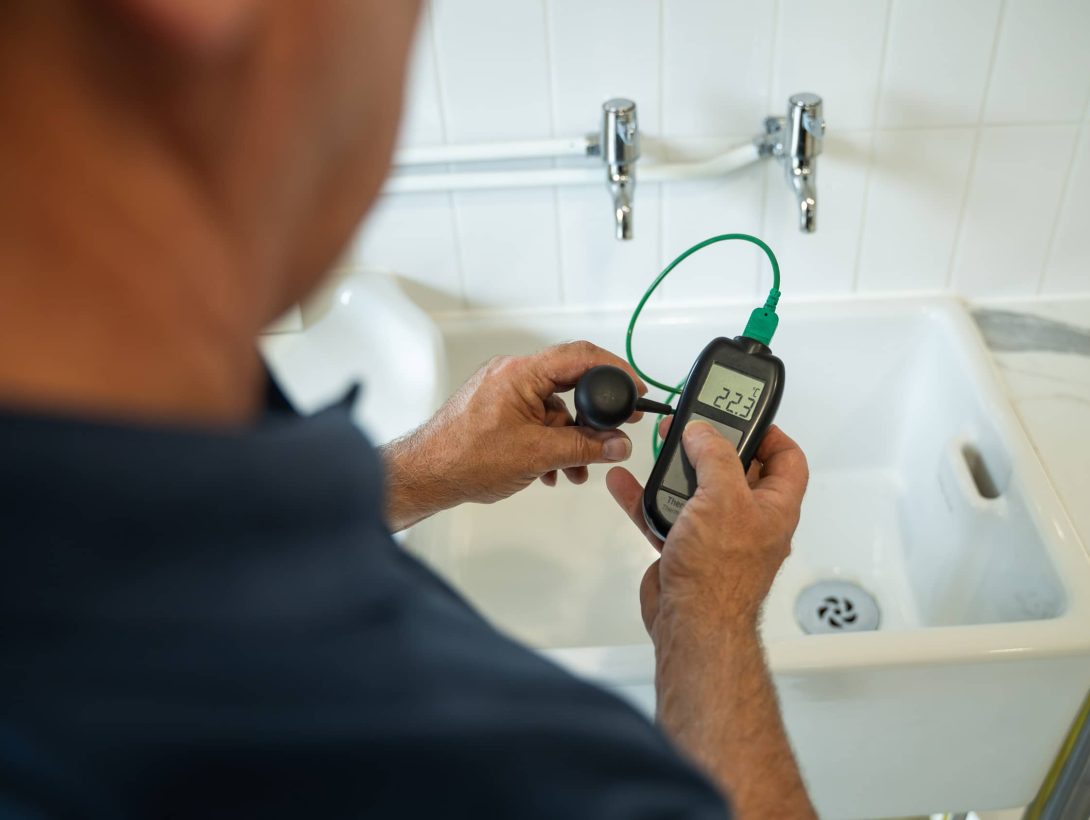
Think of a Legionella risk assessment as a full health-check of the water in your building. A competent assessor traces the system from end to end including storage, heating, distribution and every outlet, and judges where conditions might allow Legionella bacteria to take hold. It’s carried out to BS 8580-1, the British Standard that defines what a competent assessment looks like, so the methodology is recognised and stands up to scrutiny.
Legionella is naturally present in water and only becomes a problem when it multiplies, which it does in stagnant water held roughly between 20 °C and 45 °C, particularly where scale or sediment build up. Anywhere water can escape as a fine, breathable spray — such as showers, taps, cooling towers and spa pools — raises the stakes.
The assessment pinpoints those weak spots, grades them and tells you what to tackle first.
The responsibility for controlling Legionella risk falls to the duty holder. This could be the employer, landlord, building owner or managing agent in control of the premises, and it applies right across the sectors. A few Manchester property types recur, though.
The build-to-rent towers around Deansgate and Salford Quays, with their shared risers and amenity floors, carry particular responsibilities, as do the city-centre hotels and restaurants of the Northern Quarter and Spinningfields, where guest rooms and spa facilities add complexity. The universities, hospitals and care homes of Greater Manchester run large, often older water networks that need close attention, and so do the offices and laboratories of the surrounding science and tech estate.
Leisure adds another layer, as swimming pools, spa pools and cooling towers are higher-risk systems that always fall within scope. And for residential landlords, the duty holds whether you let one flat or a thousand, you must assess and control the Legionella risk in the systems your tenants rely on.
Several pieces of legislation combine to make Legionella control a legal duty rather than a choice. The Health and Safety at Work etc. Act 1974 places the general obligation on employers and anyone in control of premises, and the Control of Substances Hazardous to Health Regulations 2002 (COSHH) require hazardous substances, Legionella included, to be properly controlled. The “how” comes from the HSE’s Approved Code of Practice L8 and its technical companion HSG274 Parts 1 to 3, while the assessment itself is carried out to BS 8580-1:2019.
In practice, the duty holder is responsible for making sure a suitable assessment exists and that its recommended controls are put in place and kept up. An assessment should be reviewed at least every two years and sooner if the water system, its use or the building’s occupancy changes.
Neglect these duties and the HSE can issue enforcement notices or, in serious cases, prosecute. But the more pressing reason to keep on top of them is the safety of everyone who uses the building.
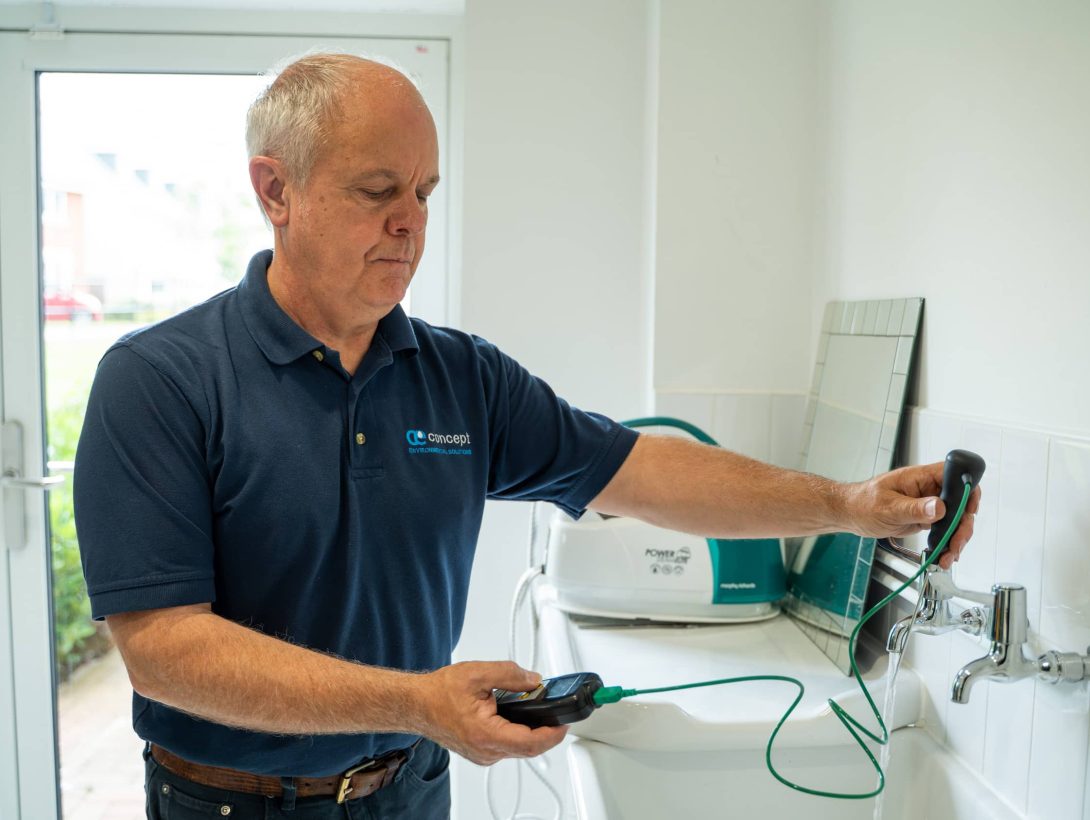
From first call to final report, we keep things clear and low-disruption.
Because every stage is handled in-house from our city-centre office, we move quickly, and we typically return your written report within five working days of the survey.

Appointing Concept means appointing a contractor your auditors and insurers will recognise. We’re LCA-accredited and a BSRIA member, with UKAS, BESA, SafeContractor, CSCS and ARMA accreditations standing behind every assessment.
That sits on real depth with more than 90 years of combined experience, over 60 specialists and four UK offices, so your work never rests on a single, overstretched individual. As part of the Celnor Group, we can bring wider environmental and compliance expertise to bear when a project calls for it.
And with our Northern Regional Office in the city centre, Manchester clients get genuinely local people and a fast response, backed by national resources.
Northern Regional Office: Neo Bruntwood SciTech, 1st Floor, 9 Charlotte Street, Manchester, M1 4ET. For more information call 01606 597 074.

Our base in Bruntwood SciTech sits right in the middle of our patch. Day to day, our assessors are on sites across Manchester city centre, Salford and Trafford, out to Stockport, Bolton, Oldham and Rochdale, and up through Bury, Tameside, Wigan and Altrincham. We are also within easy reach into Cheshire, Lancashire, Merseyside and beyond. Build-to-rent residential, city-centre hospitality and the surrounding science and tech estate make up much of that work, and multi-site clients across the North West get one consistent, accredited provider. Outside this list? Get in touch as we travel beyond the core patch.
Is a Legionella risk assessment a legal requirement in Manchester?
Yes. The duty applies UK-wide, Manchester included. The Health and Safety at Work Act 1974 and COSHH 2002 require anyone in control of a building with a water system to assess and control Legionella risk, and a documented assessment, in line with the HSE’s ACOP L8, is how you prove it. For virtually all commercial premises, it’s effectively mandatory.
There’s no fixed expiry, but at least every two years is the accepted benchmark. You should also reassess sooner if something material changes such as the water system is altered, the building’s use or occupancy shifts, or new information about a risk emerges. Regular review keeps your controls matched to the building as it actually is, not as it was.
At least every two years is the accepted standard. Review sooner, though, if the water system is altered, the building’s use or occupancy changes, or there’s any reason to think the risk has shifted. Keeping the assessment current is what the HSE expects, and what genuinely keeps people safe.
It’s priced to the building, not at a flat rate. The size and layout of your site, the number of water systems and outlets, and how the premises are used all feed into it. For example, a small office sits well below a hotel or care home. After a short scoping conversation we’ll give you a clear, no-obligation quote. Call 01606 597 074.
Yes. Build-to-rent operators and HMO landlords are duty holders for the water systems in their buildings, so the obligation to assess and control Legionella risk applies exactly as it does to commercial premises. The shared risers, communal plant and amenity spaces common in larger residential schemes can add complexity, which is all the more reason to have a properly scoped assessment. We work with residential landlords right across Manchester.
Our assessors are trained, experienced water hygiene specialists working to the competency expectations in ACOP L8 and BS 8580-1. As a business we hold LCA accreditation, the Legionella Control Association which is the recognised UK body for water hygiene providers, alongside BESA, UKAS, SafeContractor and CSCS. The person on your site knows precisely what they’re looking for.
Yes. We assess and support all three through our leisure-sector work. Because they generate aerosols and run at temperatures that can suit bacterial growth, they need particular care. Beyond the assessment we can provide the sampling, monitoring and remedial support to keep them safe and compliant.


Put your compliance on a firm footing. For a Legionella risk assessment in Manchester that’s thorough, clearly reported and handled by a local team, talk to Concept Environmental.

